
'/%3e%3cdefs%3e%3clinearGradient%20id='prefix__paint0_linear_4737_37157'%20x1='3.018'%20y1='23.6'%20x2='44.925'%20y2='24.977'%20gradientUnits='userSpaceOnUse'%3e%3cstop%20stop-color='%231CB7FF'/%3e%3cstop%20offset='.502'%20stop-color='%232FF58B'/%3e%3c/linearGradient%3e%3c/defs%3e%3c/svg%3e)


What can England learn from three huge matches where Haaland went missing?
Jul 08 2026 21:54 · By Morgan King · 0 Reads


You've probably seen the clip by now.
It's 0-0 in the 79th minute of
Brazil
v
Norway
in the
World Cup
round of 16, and
Erling Haaland
looks disinterested. Nonchalant, even. He's wandering around, head down, outside the penalty area - the very picture of an isolated No.9.
have him where they want him... or so they think. Pivot midfielders
Casemiro
and Danilo have formed a loose box around the
Manchester City
striker, with Marquinhos and
Gabriel
comfortable in their defensive shape.
A deliberate ploy of 'playing dead'. Messi-esque. Nature's ultimate predator is Erling Haaland. There are plenty of memes to choose from.
Then - out of nowhere - bang. Andreas Schjelderup glides past
Endrick
on the left and Haaland springs to life. One trademark run behind and then around the left shoulder of Gabriel later, and he's heading his country 1-0 up and on their way to a first ever World Cup quarter-final.
Gabriel is humbled. On the floor, prone. Game over in a split second of lost concentration.
It only takes a second for Haaland to make a devastating impact. Defenders across Europe have learned that lesson well since his rise to fame at
Borussia Dortmund
- but stopping him is another matter entirely.
View 6 Images
As England prepare to take on
on Saturday night, having a plan for how to deal with their danger man will be top of Thomas Tuchel's list of priorities.
We took a look at three of the very rare occasions where Haaland has failed to make an impact on the biggest stage, to see if we could find any clues as to how the England manager will set up his defence to contain the most lethal pure No. 9 on the planet.
City were locked in a three-way title race with Arsenal and
Liverpool
, who they had just drawn 1-1 with at Anfield. They faced the Gunners at the Etihad in a massive
Premier League
game.
Haaland was largely crowded out of this game, which finished 0-0. Despite having four shots, none of them hit the target with two of them blocked - accumulating an xG of 0.31.
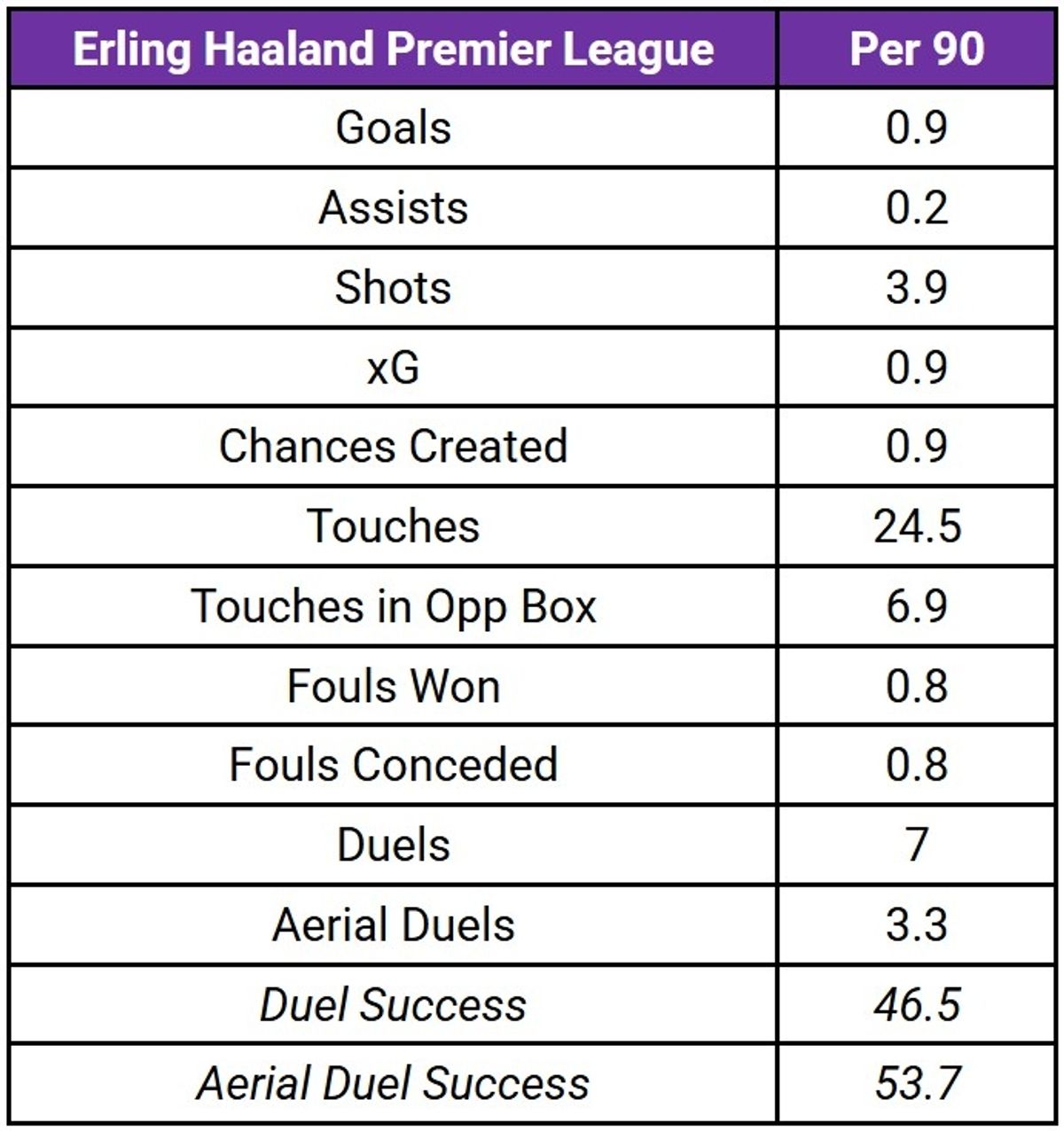
In terms of underlying numbers, this isn't necessarily bad by itself - but it is way short of his own average of 0.9 xG per 90 in the Premier League.
One of Haaland's best attributes is his movement, and the Norwegian did his best to avoid being surrounded by constantly drifting between
Ben White
and
William Saliba
towards his left, or Gabriel Magalhaes and Jakub Kiwior towards his right.
Saliba and Gabriel defended intelligently. Rather than man-marking Haaland, the pair stayed close together and, within Arsenal's compact defensive setup, were able to deny him space.
When Haaland did end up between the two
Arsenal
centre-backs, he used his strength to try and split them. Anticipating a second-half cross, he backed into Saliba to try to create more space, but Arsenal cut off deliveries into him more often than not.
This Arsenal backline was made up of giants across the four - something England will struggle to replicate with
the suspension of Jarell Quansah
, who could have featured again at right back.
But a strong defensive partnership can deny Haaland space if the full-backs are also able to stay compact and switched on.
Haaland hasn't always fired in derbies, despite United's revolving centre-half combinations over the past few seasons.
The City striker has the intelligence to avoid a big aerial defender like
Harry Maguire
, so will tend to position himself at the back post to try to overpower a full-back or, in United's case, the smaller
Lisandro Martinez
.
Haaland didn't have a sniff in this game, though. Subbed on 80 minutes, the Norwegian accumulated just 0.13 xG from two shots, both of which were blocked, also failing to win his only aerial duel.
This was largely a result of Martinez's smart, aggressive style of defending. Accounting for his own height disadvantage, Martinez followed his own blueprint of defending against Haaland by dealing with him on the front foot, ensuring he remained in front of him to make the first contact on every ball towards him and stepping out to stop him turning and driving into space in transitional moments.
This is a risky approach, but Martinez has approached Haaland like this consistently over several games including the 2024
FA Cup
Final and the Etihad derby in December 2024, both of which saw Haaland blank and United win.
Casemiro in midfield also focused more of his attention off the ball on cutting off the passing lanes towards Haaland, rather than attempting to directly stop City's dangerous creators at source.
Could this be the smaller, quicker, nimble Guehi-Anderson blueprint England will take?
As
Crystal Palace
lifted their first-ever major trophy, Haaland was restricted to just three shots - one on target and none of them from between the goalposts - for an xG of 0.24.
Facing off against a solid back three of Chris Richards, Maxence Lacroix and
Marc Guehi
, Haaland surprisingly targeted Richards rather than the shorter Guehi - but to no avail.
Early in the clash, Haaland made a trademark last-second movement towards the back post after getting behind Richards, who thought he had the cross covered, forcing a sharp save from
Dean Henderson
after a stretching volley failed to find the purchase required from the Norwegian's left boot.
Richards wised up to this quickly. In the second half, he made a vital intervention, taking two good looks at Haaland's position and this time anticipating his darting run in behind him, making the clearance before the ball reached the big man.
Palace's compact defensive structure helped them to see out the narrow victory, but this was a win that relied as much on the heroics of Henderson and some last-ditch defending to secure the cup.
In short, you might need a bit of luck - but anticipation is going to be absolutely vital for whoever is unlucky enough to find themselves marking Erling Haaland.
Re-watching Tuchel's 'Dan Burn Masterplan' against
Mexico
- six clearances as a 75th minute sub, including two headers which cleared the half-way line - the easy conclusion would be to pit England's giant against Norway's giant.
But that was a specific Tuchel game plan response to England being down to 10 men and defending crosses to hang on to a lead.
Content cannot be displayed without consent
Quansah's suspension has come at the worst possible time for England.
Haaland's movement is biased towards the left of the six-yard box for Norway, with Alexander Sorloth drifting in from the right to use his own considerable bulk to threaten defences.
This means that whoever starts at right-back will have to keep a close eye on Haaland's movement too in order not to get isolated defending against him at the back post.
Looking more closely at Haaland's performances against England's current options in the centre, though, some conclusions can be drawn.
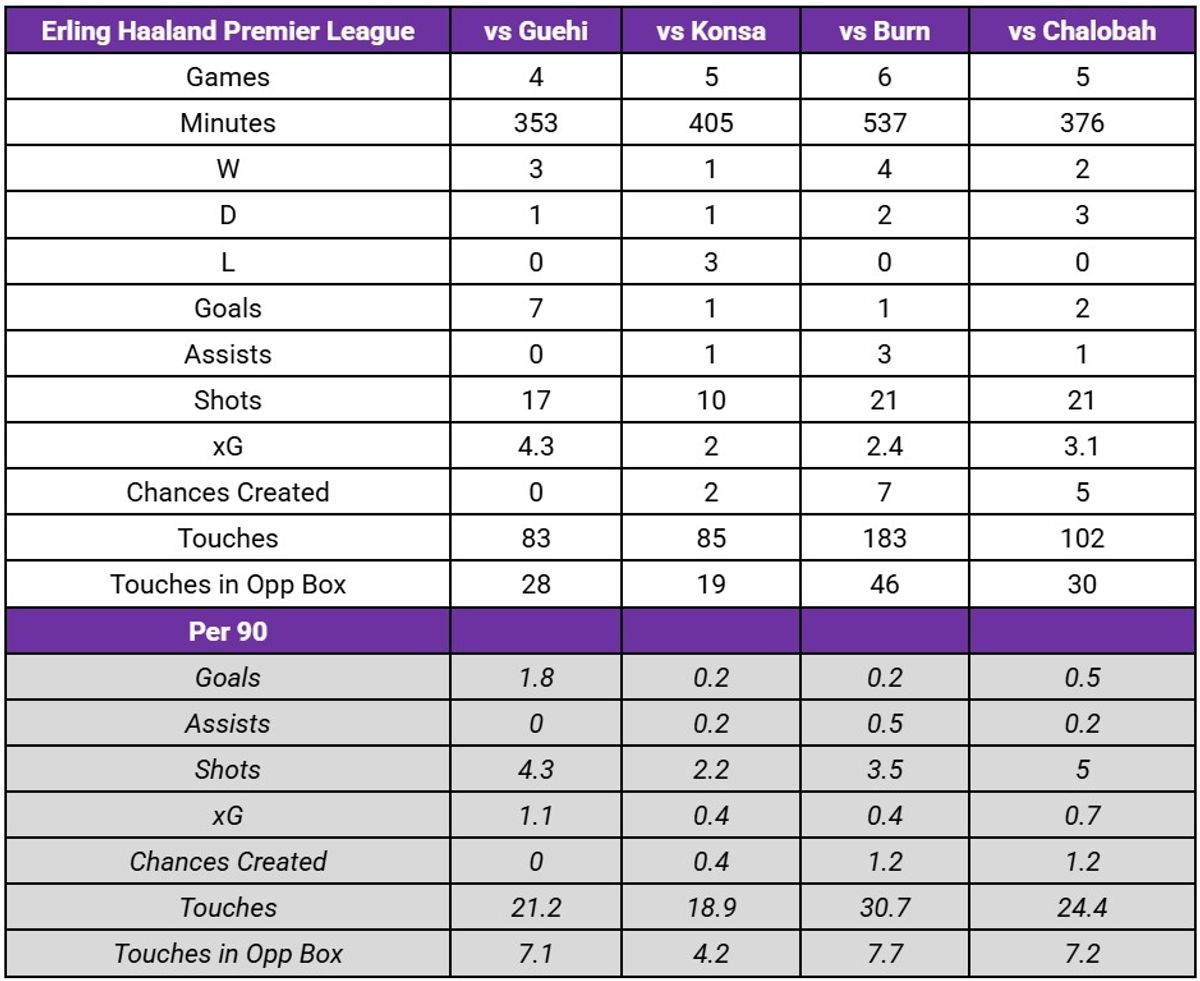
Despite playing the fewest minutes against him in the Premier League, Haaland has had the most joy against defences containing Guehi, scoring seven goals from just four appearances against his current club teammate.
He has also accumulated a higher xG (4.3) when playing against Guehi than against any of England's other options.
Ezri Konsa and Dan Burn, by contrast, have the best team records for keeping Haaland out, with the City striker only scoring once across five appearances up against Konsa and one in six against Burn.
Only Burn has played more Premier League minutes against Haaland than Konsa out of England's current options, but the No. 9 has managed significantly fewer shots per 90 (2.2) against Konsa's Villa than Burn's
Newcastle
(3.5).
Looking more closely at the interactions between Haaland and England's centre-backs, the results may be surprising.
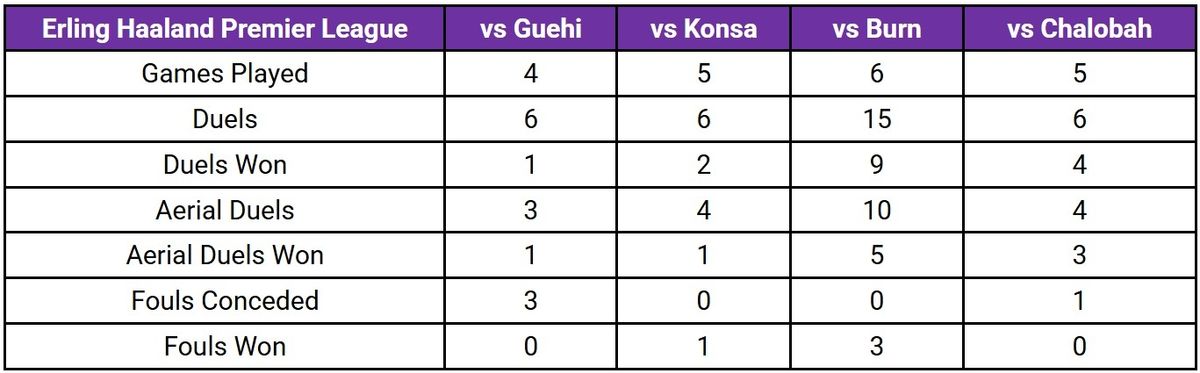
Burn has contested nearly triple the number of duels (15) with Haaland of any of his England colleagues, but has only won six of them (40%) and has conceded more fouls (3) than any of the others in the process.
In the air, Burn also has the second-worst win rate against Haaland of any of England's options, winning five of his 10 aerial duels against the Norwegian.
Konsa and Guehi, despite being the shorter centre-backs out of the four, can boast 75% and 66% aerial duel win rates against Haaland respectively, as well as 66% (Konsa) and 83% (Guehi) duel win percentages overall.
Guehi, impressively, has never conceded a foul against Haaland in the Premier League and has even won three fouls of his own up against him.
Chalobah has by far the worst record, only winning 25% of his aerial duels and 33% of his overall duels against Haaland.
Of course, the one player with possibly the best argument to start as a specific means of combatting Haaland,
John Stones
, is not represented in the data as a result of never having faced off against him on the pitch.
Stones is actually a tremendous aerial defender, winning 84.6% of his aerial duels across the minimal Premier League minutes he played last season.
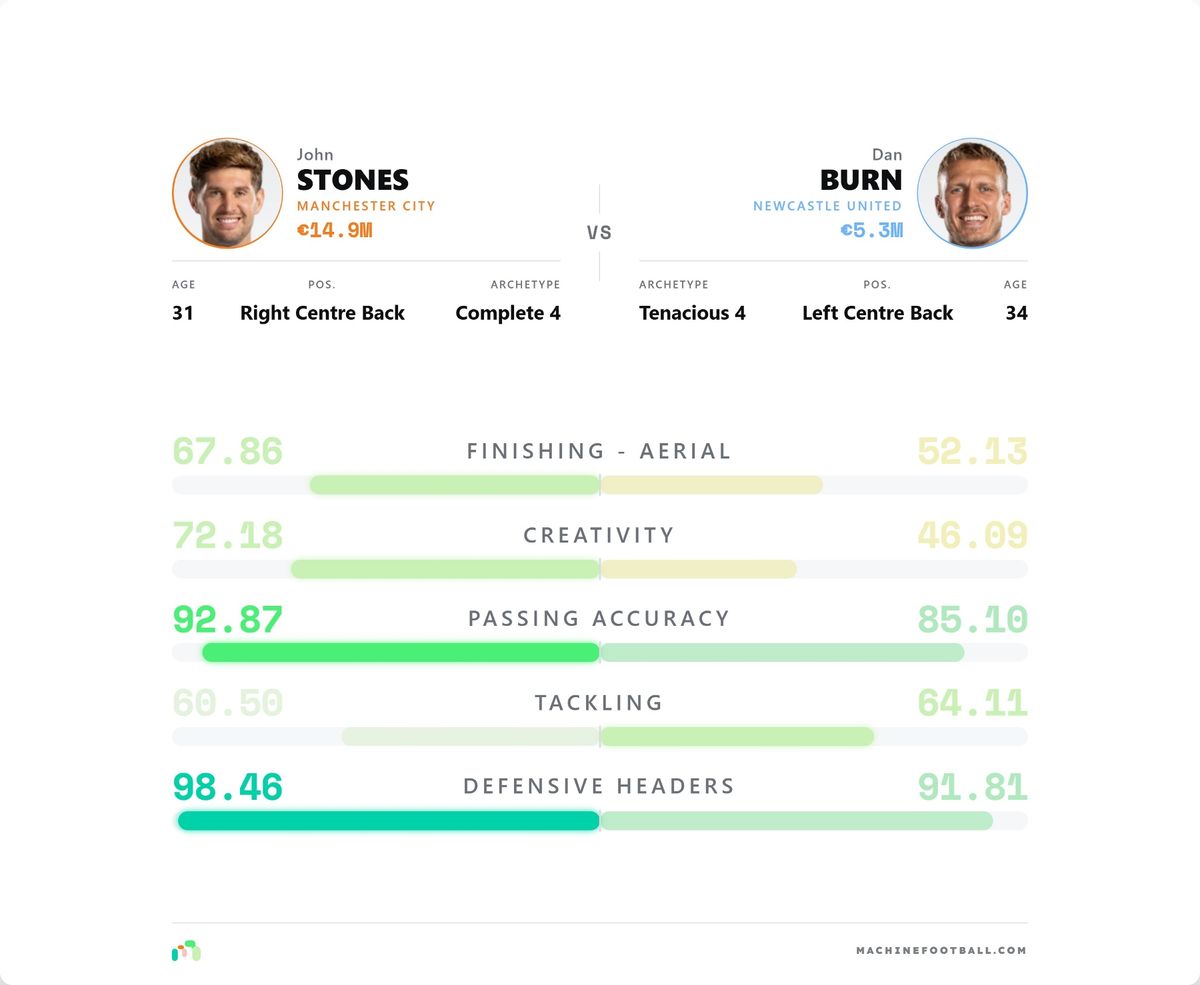
Stones also has the advantage of having trained alongside and opposite Haaland for the entirety of the latter's City career, making him more familiar with the striker's subtle movements than any other centre-back in the squad.
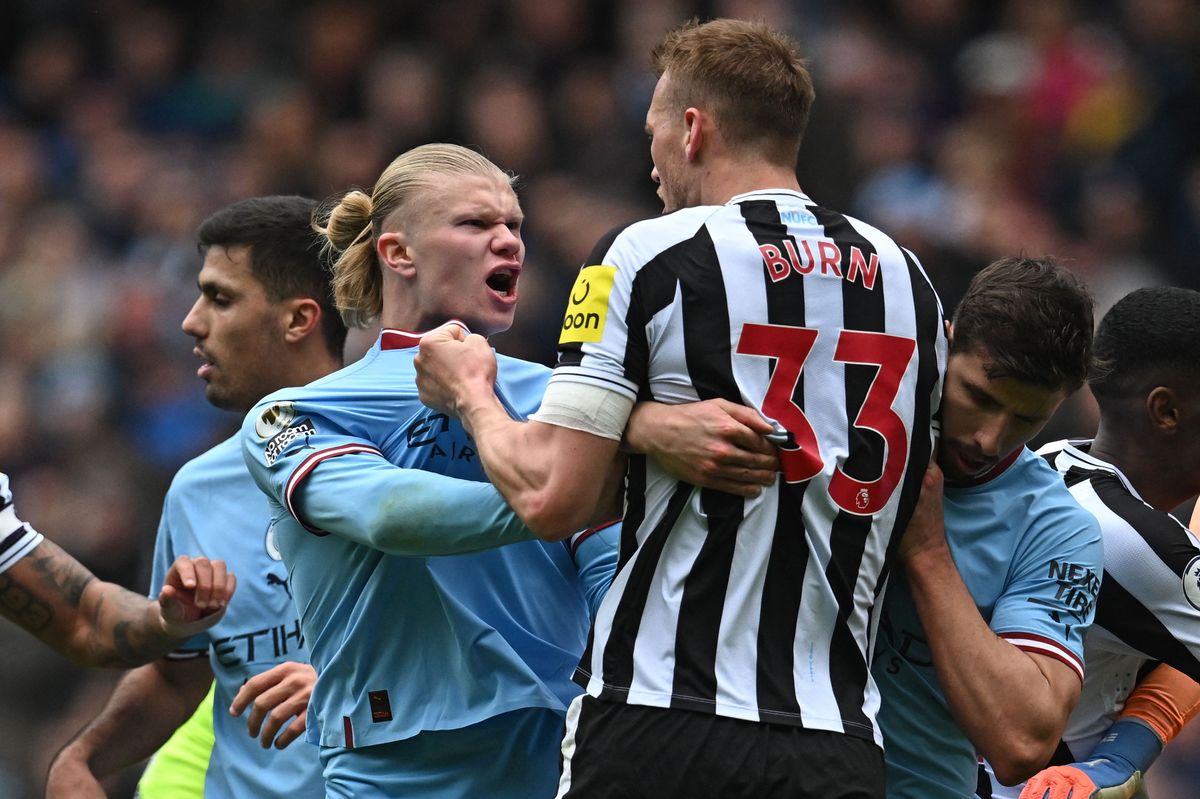
Looking at the stats above, it's hard to make the case that Burn should start as a means of stifling Haaland. While his man-marking brief has ruffled Haaland's feathers for Newcastle in the past, Burn is a far better penalty box defender than one capable of providing a reliable screen for a front-footed England approach.
Late in the game, if England are winning by a narrow margin, bringing Burn on could be just what is needed to crowd Haaland out - but
Thomas Tuchel
's best bet from the start would be to ensure that his centre-backs have a strong mutual understanding and that at least one of them can face up to Haaland in the air.
For that reason, don't be surprised to see another start for Stones, who could feature alongside Konsa against the Citizens' main goalscorer in another defensive reshuffle from Tuchel.
If Burn starts, it is more likely to be at left-back, where he can track the giant Sorloth inside into the penalty area. The identity of England's right-back could then be key to supporting the right-sided centre-back in defending against Haaland.
Could Djed Spence's speed be another weapon against Haaland. The Norwegian has hit a top speed of 31.52 km/h at the World Cup - the fastest in Norway's squad. But Spence has backed up his pacey credentials with a top speed of 33.31 km/h and that recovery pace could be vital.
Whatever Tuchel decides, the battle between Norway's goal machine and England's back line is likely to define this massive tie.